- C. B. page 73. Activities 2, 3.
 Saint Patrick's Day
, or the
Feast of Saint Patrick (
Irish:
Lá Fhéile Pádraig,
"the Day of the Festival of Patrick"), is a cultural and religious
celebration held on 17 March, the traditional death date of
Saint Patrick (
c. AD 385–461), the foremost
patron saint of
Ireland.
Saint Patrick's Day was made an official Christian
feast day in the early 17th century and is observed by the
Catholic Church, the
Anglican Communion (especially the
Church of Ireland),
[2] the
Eastern Orthodox Church, and
Lutheran Church. The day commemorates Saint Patrick and the arrival of
Christianity in Ireland,
[1] and celebrates the
heritage and culture of
the Irish in general.
[3] Celebrations generally involve public parades and festivals,
céilithe, and the wearing of green attire or
shamrocks.
[4] Christians also attend
church services[3][5] and the
Lenten restrictions
on eating and
drinking alcohol are lifted for the day, which has encouraged and propagated the holiday's tradition of alcohol consumption.
[3][4][6][7]
Saint Patrick's Day is a public holiday in the
Republic of Ireland,
[8] Northern Ireland,
[9] the Canadian province of
Newfoundland and Labrador, and the British Overseas Territory of
Montserrat. It is also widely celebrated by the Irish diaspora around the world, especially in
Great Britain,
Canada, the
United States,
Argentina,
Australia, and
New Zealand. Saint Patrick's Day is celebrated in more countries than any other
national festival.
[10] Modern celebrations have been greatly influenced by those of the
Irish diaspora,
particularly those that developed in North America. In recent years,
there has been criticism of Saint Patrick's Day celebrations for having
become too commercialized and for fostering negative stereotypes of the
Irish.
Saint Patrick's Day

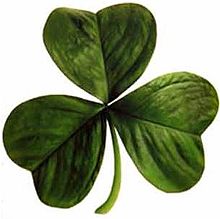
According to legend, Saint Patrick used the three-leaved
shamrock to explain the
Holy Trinity to Irish pagans.